
Investing in research and development (R&D) is essential for long-term business success, but it can be costly. The RD tax credit guide offers businesses a detailed approach to claiming the R&D Tax Credit efficiently. By using this guide, companies can reduce tax liabilities, increase cash flow, and reinvest savings into innovation, product development, and strategic growth initiatives, turning research expenses into financial advantage.
Understanding the R&D Tax Credit
The R&D Tax Credit is a government-backed incentive designed to reward businesses for engaging in qualified research activities. Unlike traditional tax deductions, which only reduce taxable income, this credit directly lowers taxes owed. It is available to businesses of all sizes and across industries including technology, manufacturing, and software development, provided the research meets IRS standards for Qualified Research Expenses (QREs).
Typical qualifying activities include:
- Developing or improving products, processes, or software
- Conducting experiments to optimize efficiency or reduce operational costs
- Testing new technologies or production methods
- Researching sustainable and environmentally friendly solutions
Who Qualifies for the R&D Tax Credit
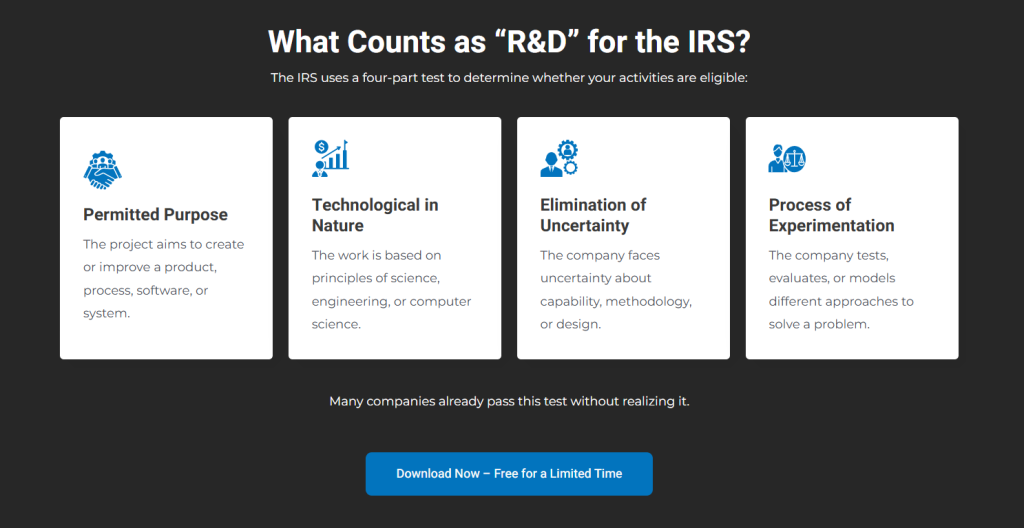
Eligibility is determined by the type of research activity, not by company size. Small businesses, startups, and individual entrepreneurs can qualify if their projects meet IRS requirements. Research must involve systematic experimentation, technological innovation, and resolution of technical or scientific uncertainty.
Key eligibility criteria include:
- Permitted Purpose: Research aims to develop or improve products, processes, or software
- Elimination of Uncertainty: Activities address technical or scientific challenges
- Process of Experimentation: Systematic evaluation of multiple solutions
- Technological Basis: Work relies on scientific principles such as engineering, computer science, or biology
Even small-scale initiatives can qualify if they follow a structured methodology and demonstrate technological advancement.
Calculating the R&D Tax Credit
Calculating the R&D Tax Credit involves identifying eligible expenses. Common qualifying costs include:
- Employee wages for research-related activities
- Costs of materials and supplies used in research
- Payments to contractors performing qualified research
- Software development and prototyping expenses
Businesses may choose between the Regular Credit method and the Alternative Simplified Credit (ASC) depending on which provides the maximum financial benefit. Accurate calculation ensures companies claim the full credit available.
Benefits of Claiming the R&D Tax Credit
The R&D Tax Credit provides several advantages:
- Direct Tax Reduction: Reduces actual taxes owed, not just taxable income
- Enhanced Cash Flow: Savings can be reinvested into research, product development, or operational improvements
- Encourages Innovation: Supports the creation of new products, processes, and technologies
- Retroactive Claims: Credits may be claimed for up to three prior tax years
- Competitive Advantage: Businesses investing in R&D maintain innovation and industry leadership
Avoiding Common Pitfalls
Companies often miss out on claiming the full R&D Tax Credit due to:
- Incomplete or insufficient documentation
- Misidentifying qualifying research activities
- Overlooking smaller projects that may still qualify
Maintaining detailed records ensures compliance and maximizes potential savings.
How K-38 Consulting, LLC Can Help
Navigating the R&D Tax Credit process can be complex. K-38 Consulting, LLC specializes in assisting businesses to identify eligible research activities, calculate credits, and prepare all necessary documentation for IRS compliance.
Partnering with K-38 Consulting, LLC allows companies to confidently claim the R&D Tax Credit, minimize audit risks, and reinvest savings into innovation and strategic growth. Expert guidance transforms a complicated tax process into a financial advantage, enabling businesses to fully leverage available incentives.
Whether conducting small experimental projects or large-scale product development, the RD tax credit guide provides the framework necessary to claim the credit effectively. Working with K-38 Consulting, LLC ensures maximum utilization of available incentives for sustainable growth and long-term profitability.
