
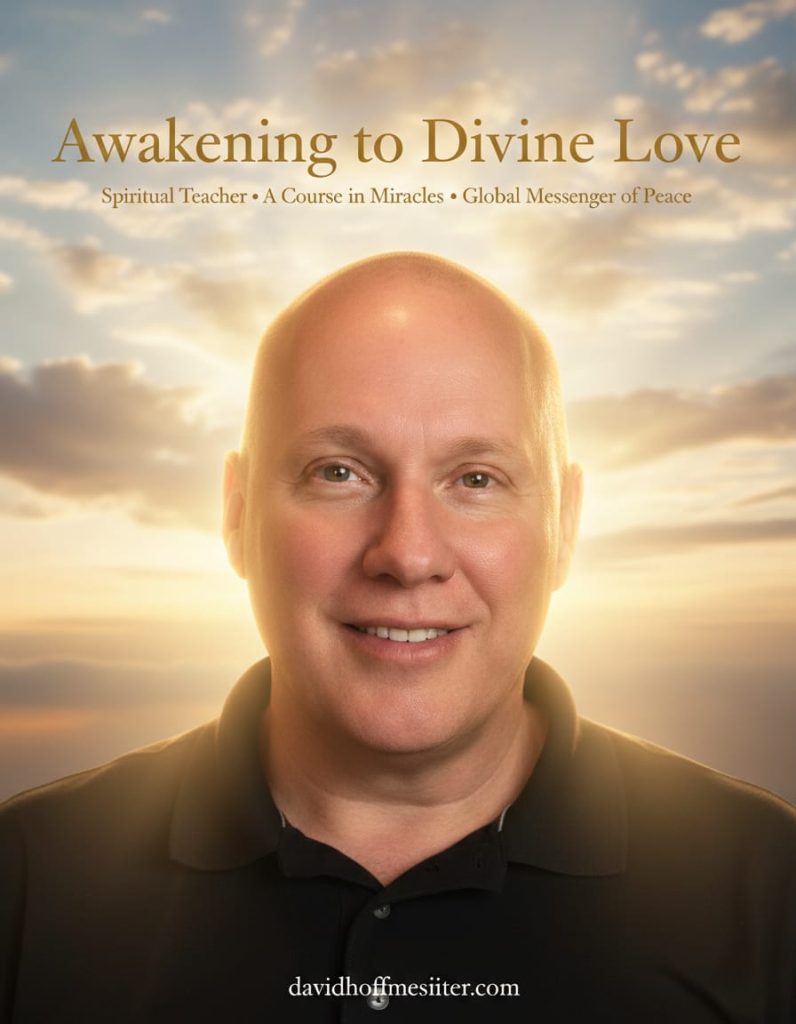
When someone searches david hoffmeister wikipedia, they typically expect a concise summary—birthplace, spiritual affiliation, core teachings, and public activities. While that type of overview provides structural clarity, it rarely captures the experiential depth about david hoffmeister and his lifelong commitment to spiritual awakening through A Course in Miracles (ACIM).
Understanding his path requires moving beyond biography into philosophy, psychological transformation, and lived spiritual application.
Early Foundations and Existential Inquiry
Before becoming widely known as a teacher of ACIM, David Hoffmeister lived a conventional American life. His upbringing and early adulthood followed familiar societal patterns—education, work, social identity, and future planning.
However, like many individuals who later embrace contemplative traditions, he experienced a growing sense that external achievement did not provide lasting fulfillment. Questions surrounding identity, purpose, and meaning gradually became more significant than professional or social advancement.
This inner questioning became the foundation for spiritual exploration.
Encounter with A Course in Miracles
In 1986, David Hoffmeister encountered A Course in Miracles, a text structured as a comprehensive mind-training program. ACIM presents a radical metaphysical proposition: the world perceived through the senses is not ultimate reality but a projection shaped by belief.
Rather than engaging with the Course intellectually alone, he adopted it as a disciplined daily practice. The 365 Workbook lessons emphasize observing thoughts, releasing judgment, and reframing perception through forgiveness.
This systematic approach distinguishes his journey. Many study spiritual literature; fewer integrate it into every decision and emotional reaction. His commitment was not theoretical—it was operational.
The Core Doctrine: Perception Determines Experience
To understand about david hoffmeister, one must grasp his central assertion: suffering originates not from events but from interpretation.
ACIM posits that the ego maintains identity through separation—defining self versus other, right versus wrong, gain versus loss. Conflict arises when perception is filtered through this dualistic framework.
David Hoffmeister teaches that forgiveness interrupts this cycle. In this context, forgiveness is not excusing behavior but recognizing that perception has been distorted by fear.
When interpretation shifts, emotional experience shifts.
Ego Dissolution and Identity
A major theme in his teachings involves dismantling ego-based identity. The ego, as defined in ACIM, is a self-concept constructed from memory, comparison, and defense.
David frequently emphasizes that personal history, grievances, and ambitions reinforce this identity. Awakening requires observing these narratives without attachment.
This does not result in passivity or indifference. Instead, it produces increased clarity and reduced emotional volatility.
The practical outcome is inner stability regardless of external fluctuation.
Radical Trust and Surrender
One of the most distinctive aspects about david hoffmeister is his emphasis on surrender to divine guidance.
Over time, he released conventional career planning, financial security strategies, and long-term goal structures. Rather than constructing life through predictive control, he adopted a posture of listening.
Guidance, in his explanation, is experienced as quiet clarity—distinct from impulsive emotion or fear-driven reaction.
This radical trust is often misunderstood. It is not avoidance of responsibility; rather, it is relinquishment of egoic authorship.
Teaching Style and Methodology
David Hoffmeister’s teaching approach is dialogical and experiential. Public talks frequently involve spontaneous question-and-answer sessions where participants describe personal dilemmas.
Rather than prescribing behavior, he asks reflective questions:
- What belief is being defended?
- What fear is being projected?
- What expectation is creating tension?
Through this method, he shifts focus from circumstance to perception.
This strategy empowers individuals to practice independently rather than relying on external authority.
Community-Based Spiritual Practice
He is closely associated with communities dedicated to living ACIM principles in practical contexts. These communities emphasize:
- Transparent emotional communication
- Shared living arrangements
- Prayer-based decision processes
- Continuous forgiveness work
The community structure functions as a real-time laboratory. Interpersonal friction becomes an opportunity for perception correction rather than conflict escalation.
Psychological and Philosophical Alignment
Though metaphysical in language, David Hoffmeister’s framework intersects with contemporary disciplines:
- Cognitive Behavioral Therapy (CBT) parallels perception reframing.
- Mindfulness practices mirror non-attachment to thought.
- Existential philosophy resonates with identity inquiry.
- Non-dual traditions align with the dissolution of separation.
However, he extends these parallels by asserting that ultimate peace arises from recognizing unity rather than merely regulating emotion.
Addressing Curiosity Beyond Biography
Many who begin with david hoffmeister wikipedia eventually seek deeper understanding about david hoffmeister beyond basic facts.
His influence cannot be reduced to dates or organizational affiliations. It lies in the consistency of lived practice. For decades, he has maintained the same central message:
- Peace is internal, not circumstantial.
- Forgiveness dissolves perceived attack.
- Guidance replaces ego-driven control.
- Awakening is practical, not abstract.
Such doctrinal consistency contributes to long-term credibility.
Global Outreach and Accessibility
The expansion of digital platforms has amplified his teachings globally. Recorded sessions, interviews, and retreats are accessible to seekers across continents.
This technological integration ensures that spiritual instruction is no longer geographically restricted. The teachings remain rooted in classical metaphysical structure while utilizing contemporary communication methods.
Practical Framework for Application
Individuals interested in practical implementation may adopt the following structure:
- Daily engagement with ACIM Workbook lessons.
- Identification of emotional triggers.
- Suspension of immediate reaction.
- Inquiry into underlying belief.
- Conscious reinterpretation through forgiveness.
Sustained repetition of this process gradually weakens ego identification.
Cultural Relevance in Contemporary Society
Modern culture prioritizes achievement, productivity, and personal branding. Anxiety and burnout frequently accompany these values.
David Hoffmeister’s model offers an alternative paradigm:
- Inner peace over competitive validation.
- Cooperation over adversarial positioning.
- Reflection over reactivity.
- Surrender over control obsession.
Such orientation directly addresses the psychological tension prevalent in contemporary life.
Longevity and Consistency
Spiritual movements often fluctuate in emphasis or leadership direction. A notable characteristic about david hoffmeister is continuity. Over decades, his teachings have not shifted toward trend-based adaptation.
This steadiness reinforces the perception that his path is grounded in disciplined conviction rather than opportunistic influence.
Conclusion
Searching david hoffmeister wikipedia offers structural insight into his background. Exploring deeply about david hoffmeister reveals a sustained life experiment in perception correction, ego dissolution, and radical trust.
His journey illustrates that awakening is neither spectacle nor ideology. It is disciplined application of forgiveness within everyday experience.
For those willing to test these principles through practice rather than speculation, his life provides both inspiration and methodology—demonstrating that inner peace is not dependent on circumstance but on perception itself.
